
The Missing Layer in Agent Security: Evidence, Not Just Decisions
ALLOW/BLOCK is not enough for production AI agents. Here is why evidence-first security matters: capture every action, retain rejected events, enable step-up workflows, and build audit-ready trails without slowing engineering teams.

Nyah Check
April 16, 2026 · 3 min read
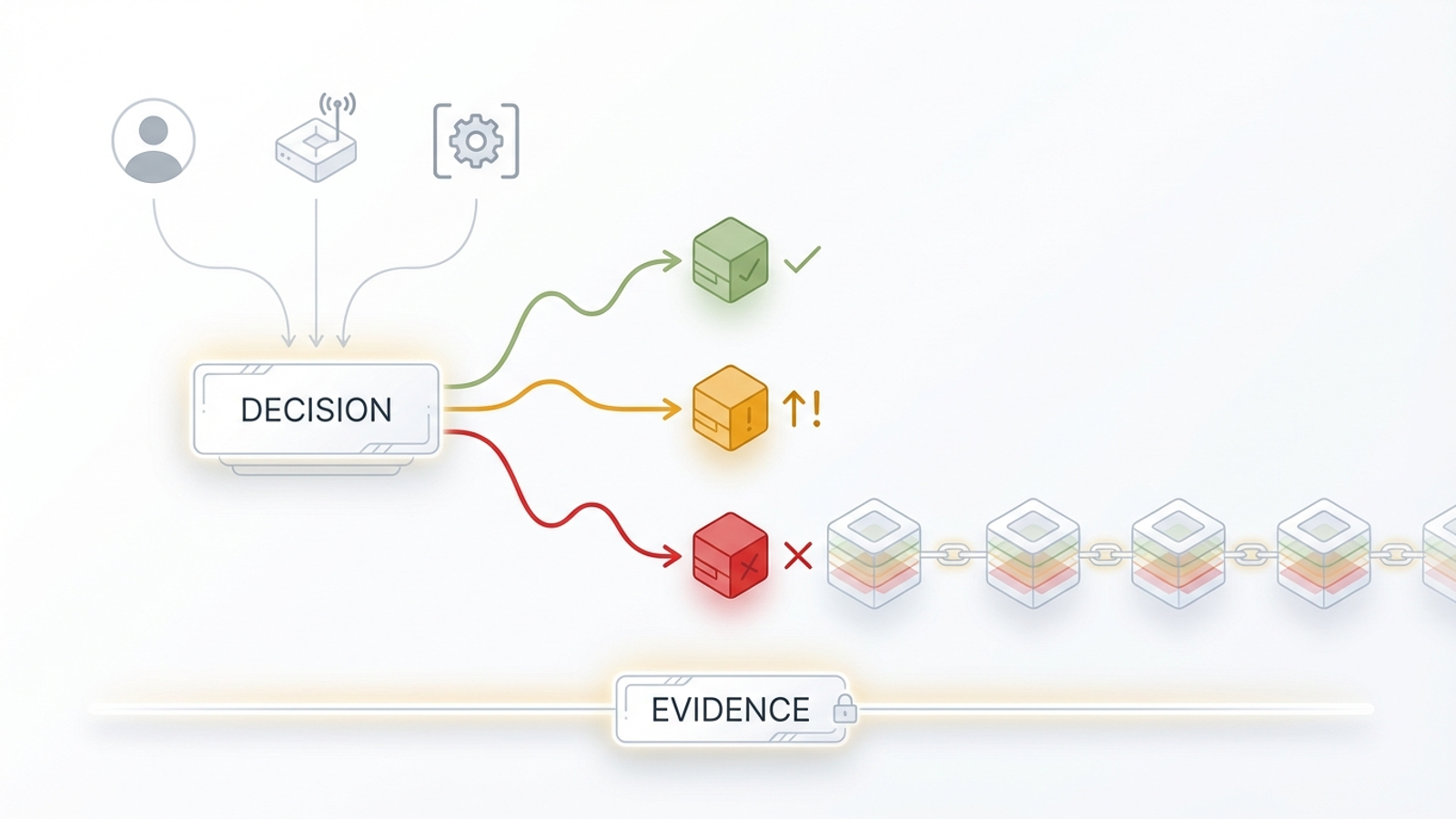
Agent security conversations usually start with one question:
"Can we block unsafe tool calls?"
That is the right question for day one. It is the wrong question for scale.
At small scale, a decision engine can look good in a demo: run a check, return ALLOW or BLOCK, and move on. But production systems do not fail because one decision was wrong. They fail because teams cannot explain what happened across the full session, endpoint, user, and tool chain.
The real security gap in agentic systems is not only decisioning. It is missing evidence. This is the same post-authorization problem: authorization happens at a moment in time, while governance must remain continuous throughout runtime behavior.
Why decision-only security breaks in production
When teams rely on decision-only guardrails, four failures appear quickly:
1. No context for incident response
Security sees a block but lacks endpoint, user, argument set, and sequence context.
2. No useful signal from rejected behavior
Blocked and step-up attempts are often dropped, even though they are high-value risk signals.
3. No reliable audit narrative
Compliance asks for evidence that controls operated over time. Decision logs alone are insufficient.
4. No learning loop
Human approvals happen, but feedback is not integrated back into runtime behavior.
The better model: evidence-first governance
Security for agentic systems should be built as a control loop:
- Observe every action (not only allowed actions)
- Decide in real time (ALLOW, STEP_UP, BLOCK)
- Capture context-rich telemetry (endpoint, user, tool, args, trace)
- Surface live operational state (feeds, command center, trend signals)
- Store tamper-evident records for audit and forensics
- Close the loop with human feedback from Slack and dashboard approvals
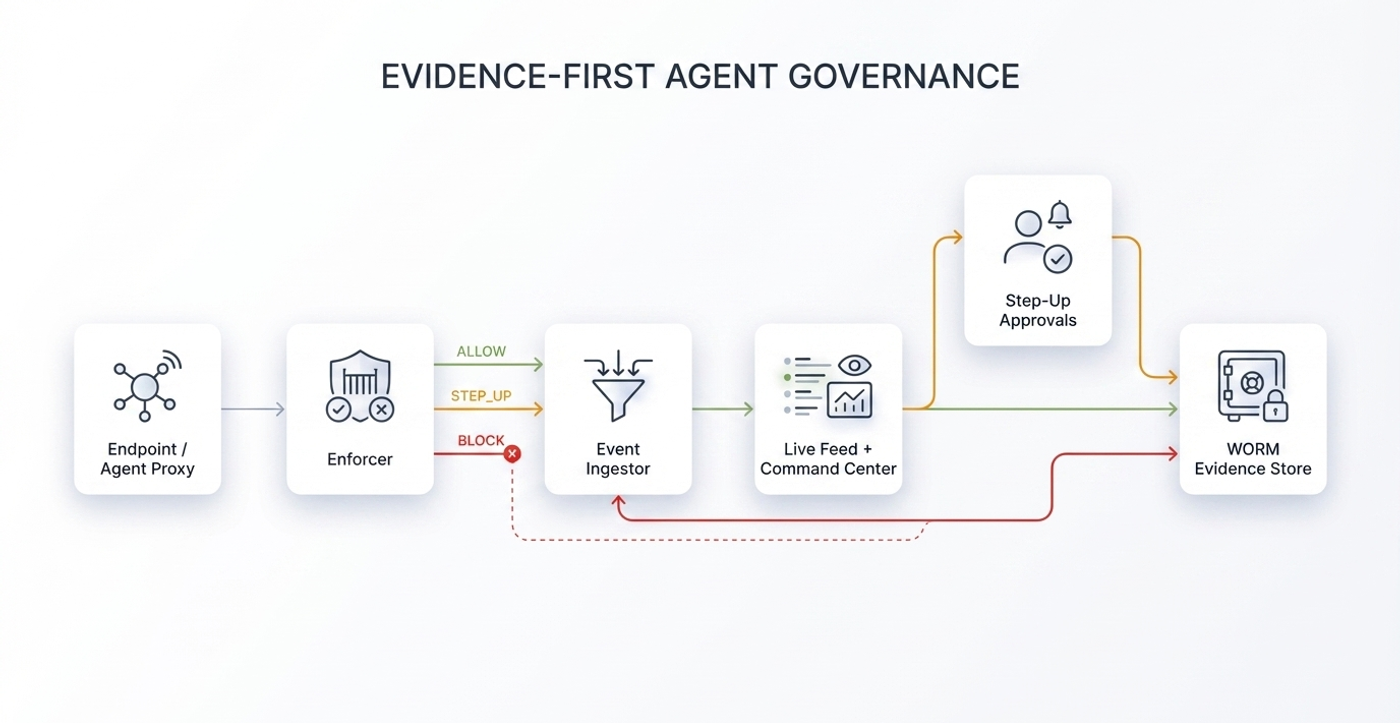
With this model, teams stop asking "did we block it?" and start asking "can we prove what happened, why it happened, and how we improved from it?"
What this means for engineering and security teams
- Platform teams get faster debugging and fewer policy blind spots.
- Security teams get higher-fidelity detection and triage signals.
- Compliance teams get defensible evidence trails.
- Product teams get safer rollout paths for high-impact automations.
In short: this is how you move from AI pilots to AI operations.
Practical rollout pattern
1. Start in observe or progressive mode to baseline behavior.
2. Normalize metadata at ingestion (endpoint, user, tool args, trace).
3. Ensure rejected events are retained and visible.
4. Add human step-up channels for irreversible operations.
5. Introduce tamper-evident evidence retention for audit paths.
6. Track policy quality with escalation and false-positive metrics.
The goal is not maximum blocking.
The goal is maximum confidence.
Final thought
Agent adoption accelerates when teams trust system behavior under stress, not when demos look clean.
If your controls stop at allow vs block, you are only halfway there.
The organizations that win in agentic AI will treat governance as a living runtime system, backed by evidence, feedback loops, and operational visibility.
Get practical updates on AI agent security and governance.
Twice monthly notes on incidents, controls, and implementation lessons from real enterprise deployments.